
Sleep as a Dynamic Process: How Our Brains Evolve at Night
New research suggests that sleep is a continuous process in which different brain regions can show very different activity, challenging the idea of distinct sleep stages.
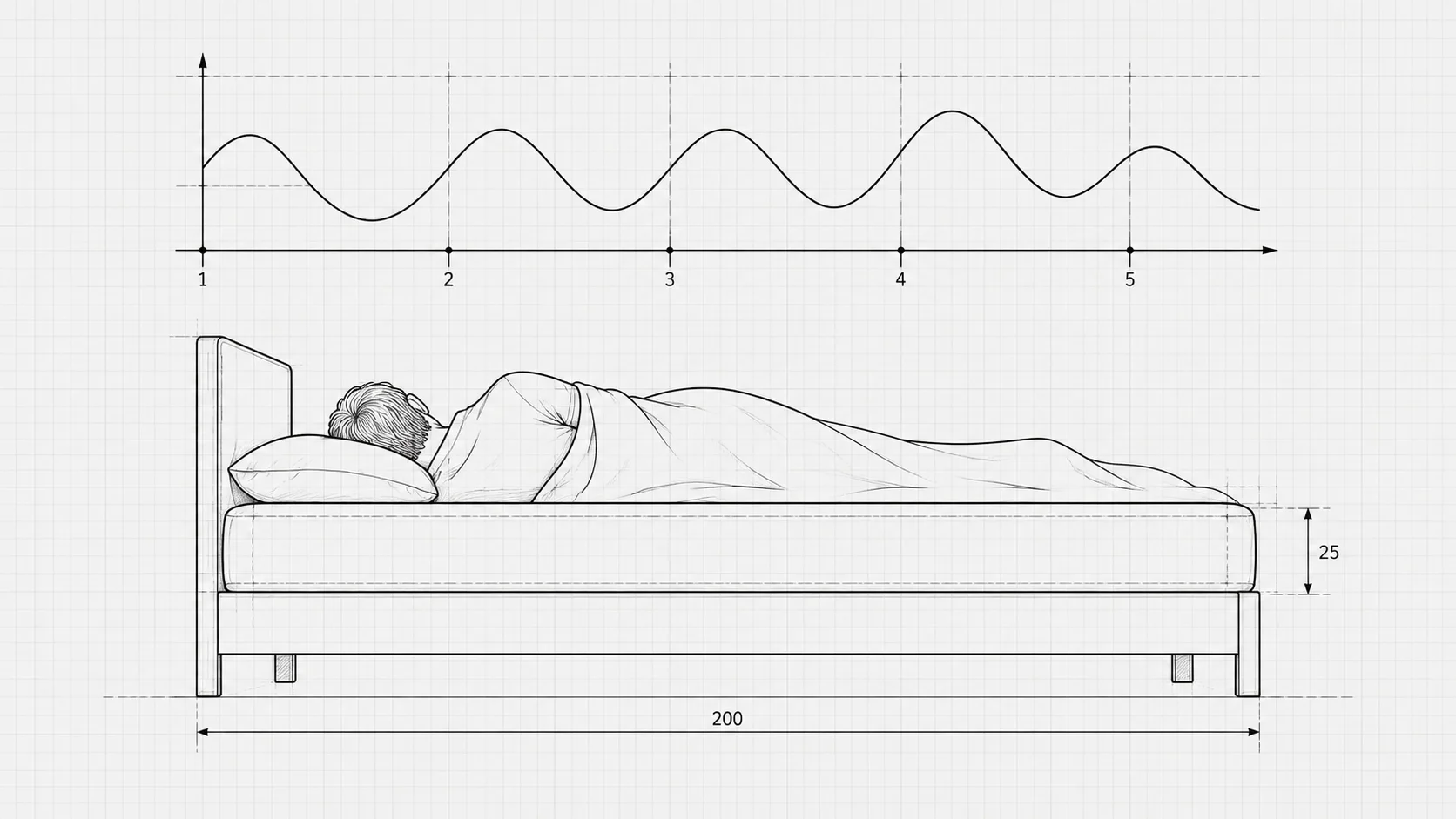
The article is written in connection with our "How Much Sleep Do You Need Calculator".
Scientists have long studied sleep as a series of clearly defined stages—like moving from one room to another. But new research challenges this, arguing that our brains don't follow such strict boundaries when we sleep. Instead, different brain regions can behave very differently at the same time, creating a mosaic of activity.
In Short Terms:
- Sleep has long been described as a collection of separate states, each with its own pattern of brain activity.
- During sleep, different brain regions or networks can show sharply different activity across time and space.
- The review suggests sleep is best understood as a multidimensional continuum, not a succession of separate states.
- It also proposes studying sleep through the brain processes that take place during it, not only through its states.
Sleep as a Continuum
Traditionally, sleep is seen as a set of stages—Non-Rapid Eye Movement (NREM) and Rapid Eye Movement (REM) sleep—that alternate throughout the night, as the US National Institute of Neurological Disorders and Stroke (NINDS) describes them. However, recent findings show that sleep is not so clear-cut. Different brain regions or networks can display sharply different activity in time and space, which makes it difficult to assign a single state of sleep or wakefulness to the whole brain.
One striking example is uni-hemispheric sleep, where one hemisphere of the brain sleeps while the other stays awake. According to a review by Rattenborg and colleagues, among mammals it is found only in aquatic species—whales and dolphins, eared seals and manatees—and it is common in birds. It suggests that sleep might not be as global a process as we once thought.
Brain States: A Complex Mosaic
The review describes the sleeping brain as a mosaic of contrasting dynamics. Viewing sleep as a multidimensional continuum, rather than a succession of non-overlapping, mutually exclusive states, could account for these local aspects of sleep.
Sleep stages like NREM and REM are still helpful in understanding the big picture, but the detailed story is more nuanced.
From States to Processes
The review also proposes moving away from the focus on sleep states. Sleep can instead be studied through the brain processes that take place during sleep, even if they are not specific to it. According to the author, Thomas Andrillon of the Paris Brain Institute, focusing on processes lets us see sleep for what it does rather than what it is.
He ends by noting that sleep is itself a process: the one that makes us wake up every morning with a brain that is cleaner, leaner and less cluttered.
Takeaways
The findings encourage a new perspective on sleep: instead of rigidly categorizing sleep into fixed states, we can see it as a continuous process in which different parts of the brain can behave very differently at the same time.